Urban real estate: cheap land, bad-neighbor gamble?
Hi, Lionel here. A cheap plot in the city can hide a costly real estate risk if the neighborhood makes the future property less attractive.
Before signing, look at nuisances, neighborhood safety and nearby projects, then check how they affect the plot’s price and investment profitability.
Things to do right away
- Visit the plot at different times, especially in the evening and on weekends.
- Look out for noise, odors, lack of privacy and possible loss of sunlight.
- Check the PLU (local urban plan) and ask about construction projects nearby.
- Compare recent sales in the same micro-neighborhood, not just the town’s average price.
- Add the cost of work, any necessary protective measures and a contingency margin to your budget.
In urban real estate, a low-priced plot is only a good deal if its surroundings allow you to build and resell under favorable conditions. To establish a benchmark price and examine the area’s influence, also consult this guide to estimating the price of a plot of land and this analysis of the impact of the neighborhood on property value.
The neighborhood can have a major impact on the value of an urban plot
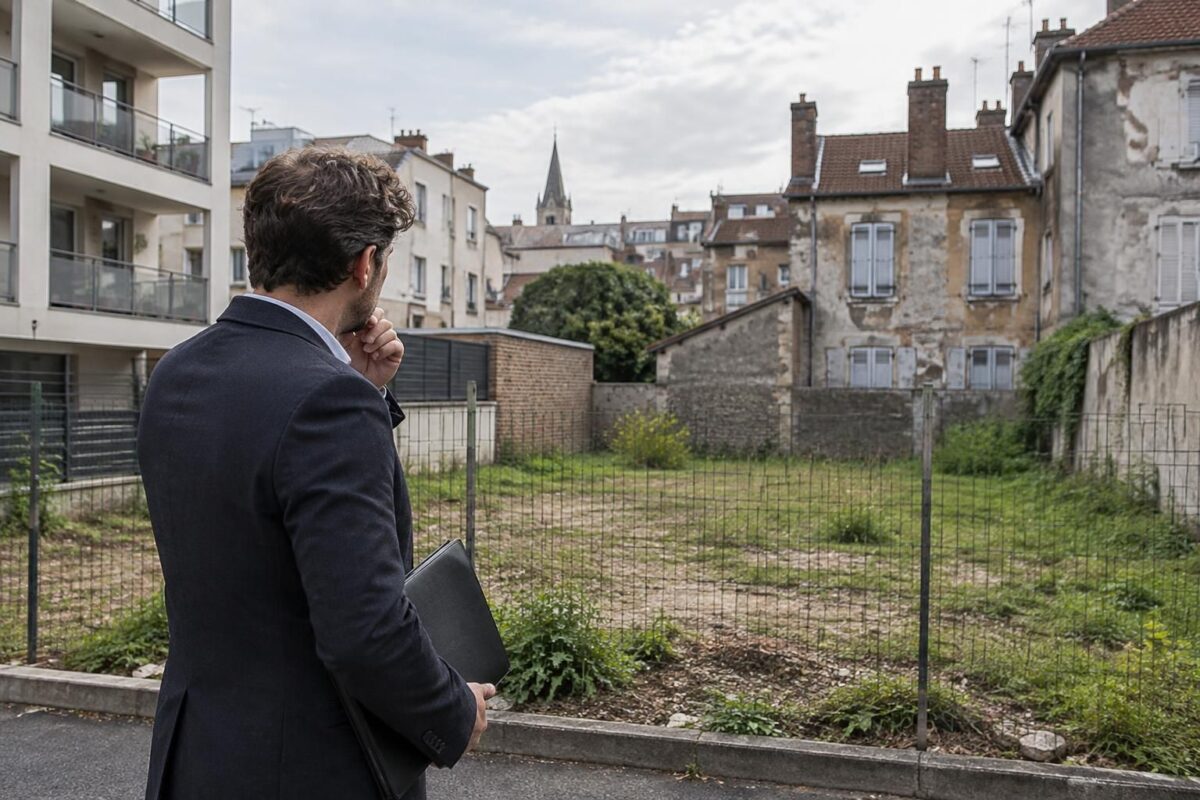
The asking price does not tell the whole story. A well-located plot can lose some of its appreciation potential if it borders a dilapidated building, a noisy business or an abandoned lot that could be used for a disruptive project.
In one case observed in a residential area of Val-d’Oise, nuisances linked to a neighboring business and uncertainty surrounding a neglected plot contributed to an estimated value reduction of around 6%, despite substantial renovation work. This example is a reminder that money invested does not guarantee the market will recoup it at resale.
Discounts vary considerably depending on the property and the area. As a rough guide, partial loss of sunlight can represent around 5%; repeated noise nuisances or poorly received densification can have an impact of 15 to 25%. In the most damaging situations, particularly where safety is affected or the view is severely compromised, the decrease can reach 30 to 40%.
A disadvantaged neighborhood doesn’t explain everything
A neighborhood’s reputation is not enough to judge a plot. Two nearby streets can have very different atmospheres, noise levels and resale prospects: the surrounding area must therefore be assessed at the level of the plot and its immediate surroundings.
You should also distinguish between a temporary nuisance and a lasting factor. A temporary construction site does not have the same impact as a noisy terrace open every evening, a loss of privacy caused by a new building or a maintenance problem that has persisted for several years.
Market discount and abnormal disturbance: two different questions
A nuisance can lower the market price without automatically entitling you to compensation. Legally, the disturbance must go beyond the ordinary inconveniences of neighborhood life, and you must establish certain harm as well as a direct link between the disturbance and that harm.
An expert assessment can help quantify a loss in market value, but legal proceedings remain uncertain and can take time. Before considering legal action, keep dated evidence: photos, noise readings, correspondence with neighbors or the condominium association, and an expert’s opinion.
| Factor observed | Possible effect on the property | Useful check |
|---|---|---|
| Loss of sunlight | Indicative discount of around 5% | Observe the plot at different times and check the planning rules |
| Frequent noise or disruptive activity | Around 15 to 25% in some cases | Visit in the evening, on weekends and during periods of activity |
| Safety concerns or severely compromised view | Up to 30 to 40% in the most serious situations | Assess local demand and obtain a well-supported valuation |
| Abandoned neighboring plot | Risk related to upkeep and a future project | Check the PLU and ask the town hall about any known permits |
These ranges are guidelines, not an automatic scale: the area, property type, local demand and the possibility of remedying the nuisance all affect the result. The key is to compare these factors with comparable transactions.
Assess the potential for appreciation before buying
A plot priced below neighboring lots may represent a genuine opportunity, but it may also reflect a constraint that buyers have already factored in. To avoid confusing the two, compare similar properties in terms of size, buildability, access, aspect and surroundings.
Sales recorded in the DVF database provide a useful benchmark for completed sale prices. Supplement them with an on-site visit and by looking at time on the market, negotiations and available listings: an average price per square meter reveals neither a specific nuisance nor the depth of demand.
Example: two plots of comparable size are a few streets apart. The first has quiet access and unobstructed sunlight; the second borders a noisy business. If the second is listed at 10% less, check whether the difference really covers the necessary improvements and the likely resale discount.
The calculation doesn’t stop at the purchase price
Include the cost of any work needed to preserve privacy or reduce noise in your budget: fencing, insulation, planting, screening or changes to the layout. These expenses can reduce your margin without eliminating the nuisance at its source.
For an investor, the calculation must also take into account the rent that can realistically be achieved, the risk of vacancy and ease of resale. An attractive return on investment on paper can erode if future occupants negotiate heavily or the property remains on the market for a long time.
Three steps to make a decision without buying blindly
- Investigate the plot. Visit several times, talk to neighbors and look out for nuisances at different times of day. Check the PLU, known projects and official information about risks.
- Quantify the impact. Compare relevant transactions, request an independent valuation and include the cost of work and a safety margin in your overall budget.
- Set your maximum purchase price. Weigh the asking price against the appreciation potential and resale liquidity. If the project only remains worthwhile on the assumption that the nuisances will soon disappear, renegotiate or walk away.
A good deal isn’t necessarily the cheapest plot: it’s one whose constraints are understood, quantified and compatible with your plans.
Frequently asked questions about the neighborhood and buying an urban plot
Does an abandoned neighboring plot automatically lead to a discount?
No. Its impact depends on the site’s condition, observed nuisances, possible projects and local demand. Check the planning rules and compare nearby sales before estimating the discount.
Does a neighborhood nuisance always entitle you to compensation?
No. Among other things, you must demonstrate an abnormal disturbance, certain harm and a direct link between the two. An expert assessment can help evaluate the loss in value, but the outcome of legal proceedings is not guaranteed.
How can you check whether the price of a plot is really attractive?
Compare recent, similar transactions, check buildability, observe the neighborhood at different times and quantify the cost of work as well as resale risks. The asking price alone is not enough to draw a conclusion.
What discount should you expect for noise nuisances?
There is no universal rate. Depending on their frequency, intensity and the local market, significant nuisances can have a major impact on value; any estimated ranges should be confirmed by an analysis of the area and property.
Thanks for reading! Feel free to share your observations in the comments. — Lionel